
Chianti Classico NYC 2026 tasting
Notes from the industry tasting event in NY
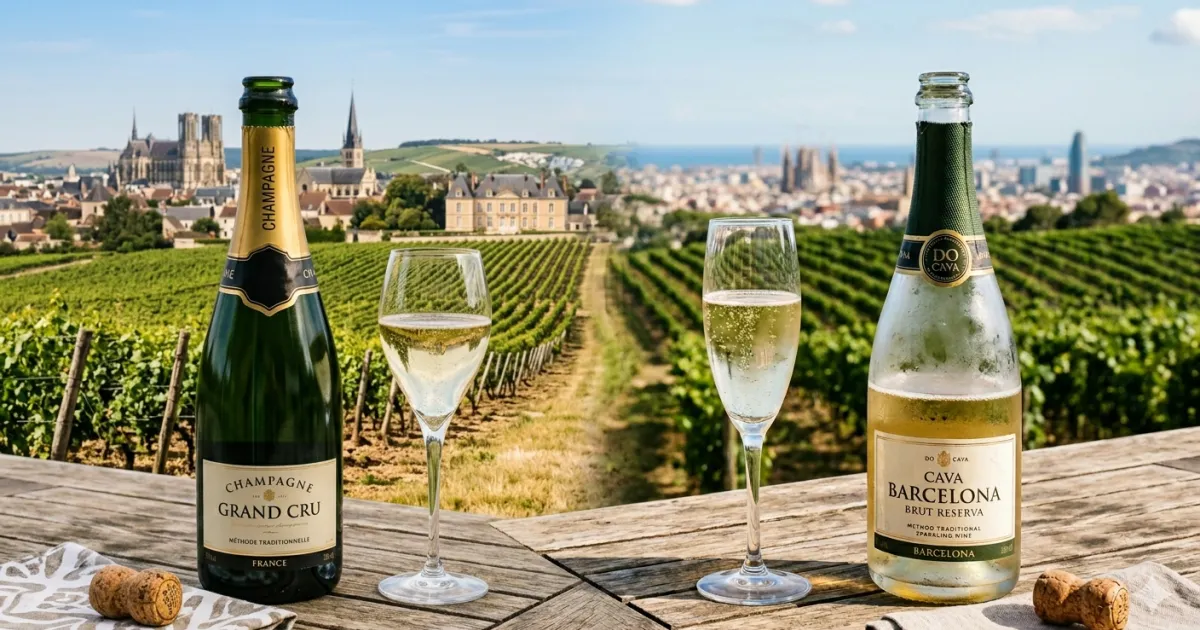
Cava and Champagne are both traditional method sparkling wines, which means the bubbles come from a second fermentation in bottle. The main difference is not that one is “real” and the other is a lesser substitute. The real differences are place, grape varieties, style, and price positioning.
Champagne is the world’s best-known sparkling wine name, while Cava is less famous internationally and often priced lower, even though it can be made to just as good of a standard as Champagne.
I’ve found that Champagne tends to be more lean, crisp, with more minerality, Cava is more lively, fruity, and less austere.
For a brief overview, you can also explore the Cava Wine Style, Champagne Wine Style, Penedès Wine Region, and Champagne Wine Region hubs.
If you only want the short version:
For many beginners, Cava is the smarter place to start. It lets you learn about traditional-method sparkling wine without immediately paying Champagne prices.
The biggest similarity is that both are made by the traditional method, with a second fermentation in bottle. That shared method is why both can show fine mousse, freshness, and complexity from lees aging.
Both categories also have meaningful quality differences within them. In Cava, the top-end categories include Reserva, Gran Reserva, and Paraje Calificado, all of which require longer bottle aging than basic Cava de Guarda. In Champagne, producer style, non-vintage versus vintage, and prestige bottlings can play a similar role in signaling seriousness and intended complexity.
So if you already like Champagne, Cava is not some unrelated bargain fizz. It belongs in the same broader world of bottle-fermented sparkling wine, even though it expresses that world differently.
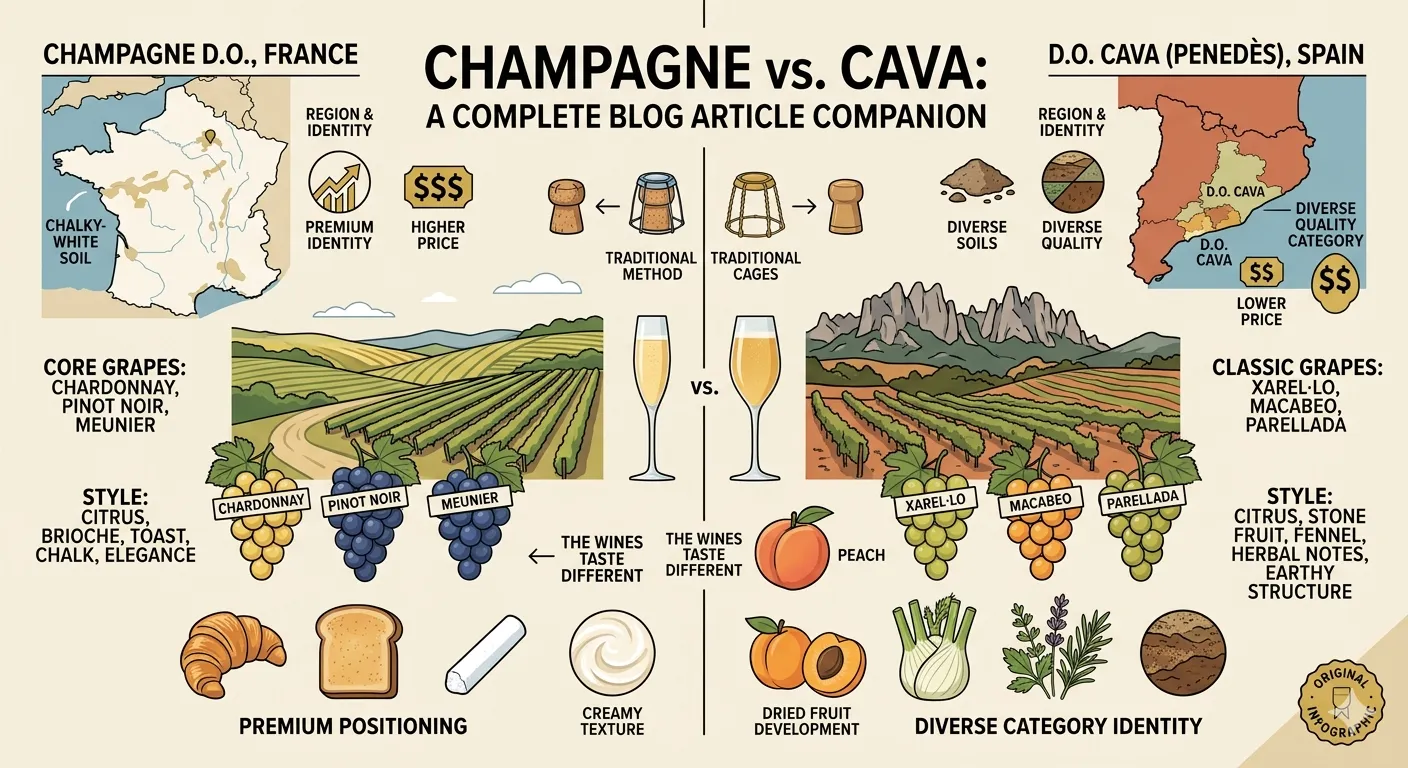
Champagne can only come from the Champagne region of France. Cava is a Spanish appellation historically centered on Catalonia, especially Penedès, though the Cava D.O. is not identical to one single region in the way Champagne is.
That matters because sparkling wine is not just about method. It is also about climate, soils, grapes, and local tradition. For example, Champagne’s chalk soils are typically cited as a reason for the minerality of the wines made there.
Champagne’s core grapes:
Classic Cava:
This is one of the biggest reasons the wines do not taste the same, even when the production method is similar.
Champagne often shows flavors that beginners describe as:
Cava can overlap in freshness and bottle-fermented character, but serious examples often lean more toward:
That is especially true when Xarel·lo plays a major role. It is one of the grapes that gives serious Cava its structure and distinct personality.
Champagne is usually more expensive, but that does not automatically mean it is always better in the glass. Part of what you are paying for is a region with extraordinary recognition and a very strong premium identity.
Cava usually sits at a lower price point, but that should not be confused with a lack of quality. One of Cava’s challenges is that inexpensive mass-market bottles and fine long-aged bottles share the same category name, so the top wines often do not get the same recognition they deserve. The Cava regulatory organisation is making an effort to distinguish these categories to help consumers differentiate.
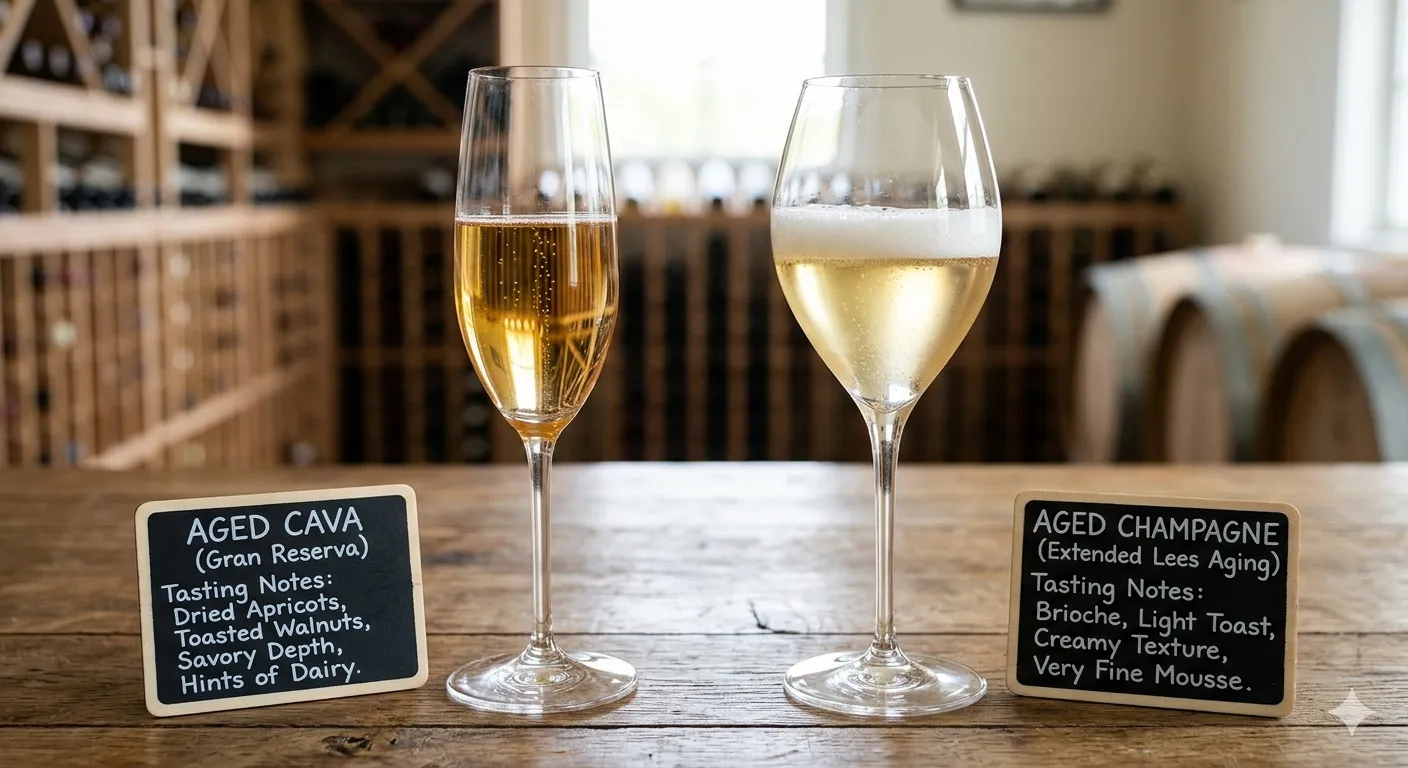
Both wines gain complexity from time on the lees, but they do not always express that aging in the same way.
In Cava, longer aging often shows as a move from fresh fruit to dried fruit and savory depth, rather than simply more overt brioche character. In Champagne, many drinkers more readily associate extended lees aging with toast, brioche, cream, and very fine mousse.
I’ve sometimes found more dairy notes in aged Cava.
One important point for beginners: the legal minimums are only minimums. In Cava, Reserva, Gran Reserva, and Paraje Calificado require at least 18, 30, and 36 months respectively, but respected producers often age their wines much longer.
That is one reason it is too simplistic to treat Cava as inherently less serious than Champagne. Cava can offer long-aged traditional-method wines at a much lower price.
This is where the beginner choice often becomes easiest.
If your budget is modest but you still want a bottle-fermented sparkling wine with real character, Cava is often the better value.
If your goal is:
then Champagne is the more obvious choice.
But if your goal is:
then Cava is often the smarter buy.
Try a more serious aged Cava, especially one with more aging or stronger Xarel·lo presence.
Start with:
Cava is not “cheap Champagne.” It is a different category of traditional-method sparkling wine with its own grapes, its own culture, and its own strengths. Champagne remains the world’s most famous sparkling-wine name, but great Cava offers something very appealing: real quality, distinctive personality, and often much better value.

Notes from the industry tasting event in NY

A beginner-friendly guide to the main styles of Port

A beginner-friendly guide to the most important Cava label terms, from Brut Nature and Guarda to Gran Reserva and Paraje Calificado
Comments